

Member Support
The entire phone tree — every option, every transfer, every dead end — replaced by a single conversation. No menus. No wrong doors. No member left navigating your org chart.
The Phone Tree Problem
Your members know the experience by heart. Press 1 to file a claim. Press 2 for questions about an existing policy. Press 3 for a new quote. Press 4 to spell a name on a dialpad. Press 5 if you happen to know an extension. Press 9 to hear it all again. Five options at the front door, over a hundred and fifty possible destinations behind them, and the member is the one doing the routing.
One in five callers picks the wrong option. They don’t know whether a billing dispute is Option 2 or Option 1. They don’t know whether adding a vehicle is a policy question or a new quote. They press a number, wait, explain their situation for thirty seconds, and then hear: “Let me transfer you to the right department.” The call starts over. The context doesn’t follow. Your team member on the other end asks the same questions from the top.
That’s not a technology problem. It’s a design constraint. A dialpad has ten keys. A member’s needs don’t fit into ten categories — or five, or three. The phone tree forces callers to sort themselves into buckets that make sense to your org chart, not to them. And when they sort themselves wrong, your staff absorbs the cost: thirty to ninety seconds of listening before realizing the caller landed in the wrong place, then a transfer that throws away everything that was just said.
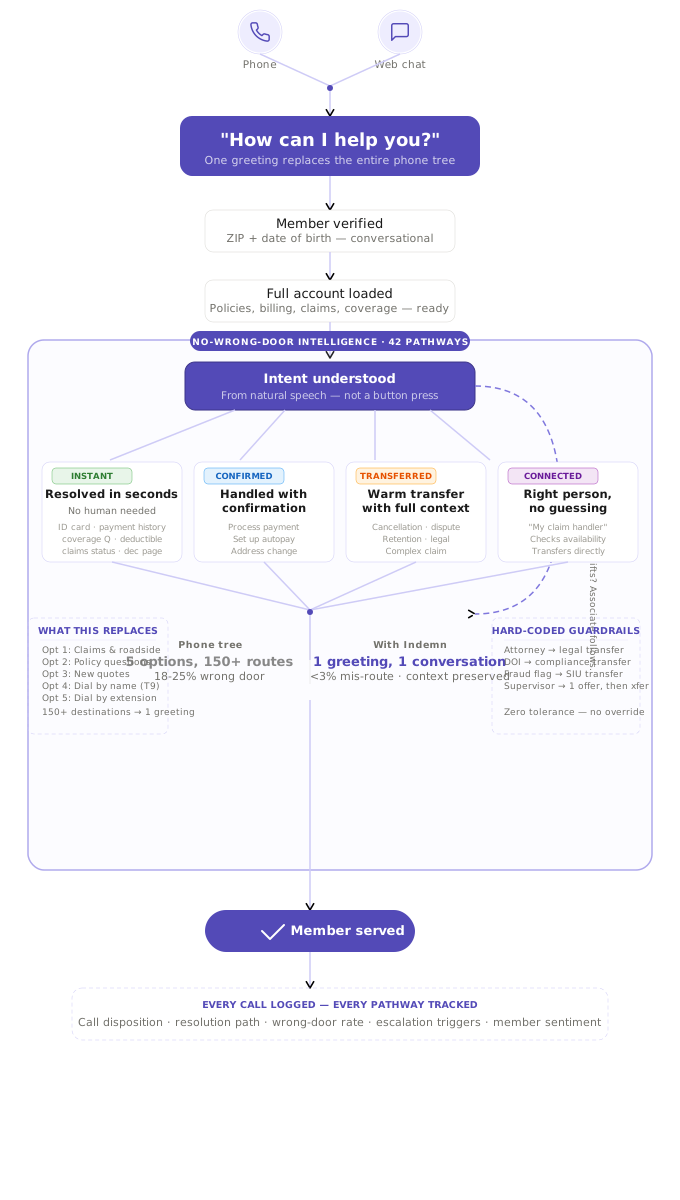
The Care Associate eliminates the phone tree entirely. Not a better menu — no menu. A member calls and hears a voice: “Thank you for calling Branch Insurance. How can I help you?” That’s it. The member says what they need in their own words. The associate understands the intent, verifies identity through natural conversation, pulls the full account in the background, and either resolves the request or connects the member to exactly the right person — with every detail already handed off.
When a member says “I need to talk to the person handling my roof claim,” the associate doesn’t ask them to spell a name on a keypad. It looks up their open claims, finds the assigned claims guide, checks availability, and transfers the call. When a member starts asking about billing and mentions “my lawyer is handling the rest,” the associate doesn’t wait for them to navigate to a legal option that doesn’t exist on any phone tree. It recognizes the trigger and routes to your legal team immediately, mid-sentence, with full context.
There is no wrong door because there are no doors. There is one conversation, and the associate knows where it needs to go.
See It In Action
Pick a scenario. Watch the associate handle real member calls with zero menus.
Forty-Two Pathways Your Phone Tree Can't Handle
Your current IVR has five options and seven pre-coded pivots for when callers pick the wrong one. Your associate has forty-two service pathways and handles every one of them from a single conversation.
Document Requests
Five skills — ID cards, declarations pages, loss runs, cancellation letters, mortgage certificates — each resolved in under sixty seconds without a human
In the IVR: member presses 2, waits for a CSR, authenticates, explains, waits for the document. Three to four minutes. With the associate: fifteen seconds from request to delivery.
Billing & Payments
Seven skills — payment history, one-time payments, autopay setup, duplicate charge resolution, grace period education, hardship accommodation, escrow clarification
Financial transactions include mandatory read-back and verbal confirmation. No payment is processed until the member hears the amount and method and says yes.
Coverage & Policy Changes
Thirteen skills — from "Am I covered for this?" to vehicle additions, driver changes, address updates, lienholder modifications, and coverage limit adjustments
Coverage explanations stay factual — what is and isn't covered, never what should be. Policy changes route through confirmation workflows with premium impact read-back.
Claims & Status
Five skills — open claim status, payment and settlement inquiries, claims guide contact, repair and rental status, and dispute escalation with warm transfer
Members with open claims call three to four times during the life of a claim. Each status lookup is a thirty-second skill, not a four-minute phone call.
Directory & Transfers
Four skills — replacing both dial-by-name and dial-by-extension with natural speech lookup, contextual routing, and real-time availability checking
"Connect me to whoever's handling my claim" works. Spelling a name on a T9 keypad does not. The associate handles names, extensions, departments, and contextual references in one unified skill.
Escalation & Compliance
Eight skills — supervisor requests, formal complaints, DOI inquiries, legal triggers, cancellation intake, retention handoff, reinstatement routing, and fraud-flag detection
Hard-coded triggers with zero tolerance. Attorney mention stops all claim discussion immediately. DOI reference routes to compliance with contact info provided proactively. No judgment calls, no overrides.
One Workflow. Every Channel.
It doesn't matter how the request arrives. The same intelligent automation handles it.
Email Inbox
A request lands in your inbox. Our AI reads it, extracts the details, and starts working — before your team even sees it.
Phone & Voice
A caller needs a document. Our voice associate captures every detail and routes it directly into the fulfillment workflow.
Web Chat
A visitor requests a document through your website. Instant intake, instant processing.
Same automation. Same compliance. Same result.
Frequently Asked Questions
Does this actually replace the entire phone tree, or just part of it? +
The entire tree. Your current IVR has five main options — claims and roadside, existing policy questions, new quotes, dial-by-name, and dial-by-extension — branching into over a hundred and fifty possible routing destinations. The associate replaces all of it with a single conversational entry point. Every pathway that exists in the current IVR has a corresponding skill in the associate, plus contextual routing capabilities that no phone tree can offer — like connecting a member to "the person handling my claim" without knowing a name or extension.
What happens when a member's need changes mid-call? +
The associate follows the conversation, not a menu selection. If a member calls about billing and mentions an accident, the associate recognizes the intent shift and pivots to claims intake — within the same call, same voice, no re-greeting, no transfer back to a menu. In the current IVR, only seven of these "wrong door" pivots are pre-coded, and undocumented ones require the member to hang up and call back. The associate handles any intent shift from any starting point because it understands language, not button presses.
How much staff time does the wrong-door problem actually waste? +
Industry data puts the wrong-door rate for insurance IVRs at eighteen to twenty-five percent of inbound calls. Each misrouted call costs your team thirty to ninety seconds of listen time before the agent realizes the caller is in the wrong place, plus the transfer itself, plus the re-authentication and re-explanation on the other end. For a carrier handling thousands of calls per week, that's hundreds of hours per month of skilled labor spent on routing — not resolution. The associate reduces the mis-route rate to under three percent, and when a transfer is needed, the context travels with it.
Can the associate connect members to specific people — not just departments? +
Yes. The associate replaces both your dial-by-name and dial-by-extension directories with a single conversational skill. A member can say a full name, a first name with a department for disambiguation, an extension number, or a contextual description like "my claims adjuster" or "whoever I spoke with last week." The associate performs the lookup — including fuzzy matching for misspelled or mispronounced names — checks availability, and either transfers the call or offers voicemail and callback options. No keypad spelling. No memorized extensions.
What does the associate do that it can't resolve on its own? +
It gathers context and warm-transfers. Cancellation requests, claim disputes, retention conversations, reinstatements, and anything involving professional judgment route to your team — but not cold. The associate passes a full context package: who the member is, what they need, what's already been discussed, what they've already tried, and how they're feeling. Your specialist starts the conversation at the point of resolution, not the point of authentication. This saves thirty to sixty seconds per handoff and eliminates the single most frustrating moment in insurance service: "Can you tell me again what you're calling about?"
How does this handle compliance-sensitive situations? +
With hard-coded triggers that never rely on judgment. If a member mentions an attorney in connection with a claim, all claim discussion stops immediately and the call transfers to your legal queue — no delay, no "let me check." If a member references the Department of Insurance, the associate provides DOI contact information proactively and routes to compliance. If an account carries a fraud or investigation flag, the associate completes verification normally and then routes to your special investigations team with a neutral handoff — no flag disclosed, no suspicion aroused. These are zero-tolerance triggers built into the Associate, not guidelines it interprets.
Can we deploy this in phases rather than replacing the whole IVR at once? +
Yes, and the Associate is designed for it. Every skill has a configurable tier — from fully automated to human-only with associate intake. A typical deployment starts with the lowest-risk, highest-volume skills: document delivery, payment history, coverage questions, and claims status lookups. These alone account for roughly two-thirds of routine call volume. You expand from there — adding payment processing, policy changes, and directory services as your team builds confidence. At every phase, the skills that aren't yet active route to your team exactly as they do today, with the added benefit of the associate gathering context before the handoff.

Replace the Phone Tree. Keep the People Where They Matter.
Your members already call you. Your team already has the answers. The only thing standing between them is a five-option menu that sends one in five callers to the wrong place. Remove it.